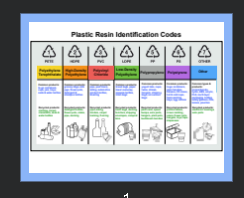

Have you ever wondered what those tiny numbers on the bottom of your plastic bottles actually mean? They aren’t a "recycle-o-meter"—they are Resin Identification Codes (RIC) that tell you exactly what kind of plastic you're holding.
Image result for recycling numbers 1-7 chart:
The Plastic Code Breakdown
#1: PET (Polyethylene Terephthalate)
Found in: Water and soda bottles, peanut butter jars.
Recyclability: Widely accepted.
Note: Best for single-use; repeated use can lead to bacterial growth.
#2: HDPE (High-Density Polyethylene)
Found in: Milk jugs, detergent bottles, shampoo bottles.
Recyclability: Widely accepted.
Note: One of the safest plastics and very easy to recycle into new containers or plastic lumber.
#3: PVC (Polyvinyl Chloride)
Found in: Cooking oil bottles, clear food packaging, plumbing pipes.
Recyclability: Rarely accepted.
Note: Contains phthalates; generally best to avoid for food contact if possible.
#4: LDPE (Low-Density Polyethylene)
Found in: Squeeze bottles, grocery bags, bread bags.
Recyclability: Often requires store drop-off rather than curbside bins.
#5: PP (Polypropylene)
Found in: Yogurt containers, syrup bottles, bottle caps.
Recyclability: Increasingly accepted in curbside programs.
Note: High melting point makes it ideal for hot liquids.
#6: PS (Polystyrene)
Found in: Disposable cups, meat trays, egg cartons.
Recyclability: Hard to recycle and often rejected.
Note: Commonly known as Styrofoam; can leach styrene.
#7: Other
Found in: Large water jugs (5-gallon), baby bottles, polycarbonate.
Recyclability: Rarely accepted.
Note: This is a catch-all for mixed plastics; check labels for "BPA-free" or "Compostable" (PLA).